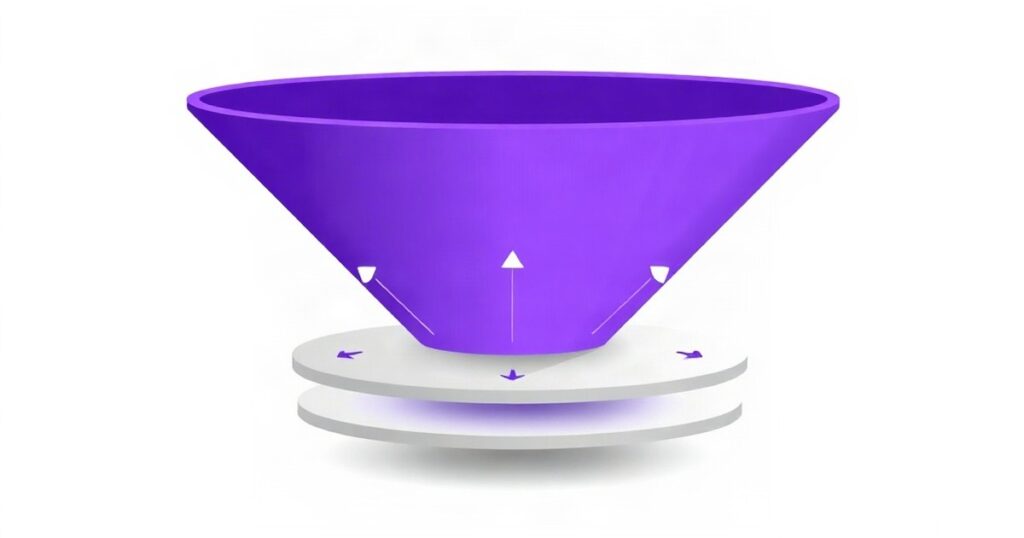
Most marketing funnels fail not because the concept is wrong, but because they’re built backwards — companies design the funnel around their own sales process instead of the customer’s decision-making process. The result is messaging that pushes too hard too early, retargeting that annoys instead of persuades, and conversion rates that never seem to improve no matter how much budget you add.
This guide walks through how to build a funnel that maps to how buyers actually behave — from first awareness through to purchase and beyond.
What a Marketing Funnel Actually Does
A funnel is a framework for delivering the right message to someone based on where they are in their decision process. It’s not a linear pipeline — modern buyers move back and forth, research across multiple channels, and take anywhere from two days to six months to commit, depending on what they’re buying.
Your funnel’s job is to be useful at every stage, not just at the moment someone is ready to buy.
Stage 1: Awareness — Reaching People Who Don’t Know You Yet
At this stage, your audience has a problem or a need but may not be actively searching for a solution — and almost certainly hasn’t heard of you. The goal is not conversion. The goal is to make a credible first impression.
What works at awareness stage:
- Meta and YouTube broad-audience campaigns — Video content and scroll-stopping creative targeting cold audiences by interest, behaviour, or lookalike segments
- SEO-driven top-of-funnel content — Blog posts and guides targeting informational search queries (e.g. „how to reduce customer acquisition cost”)
- LinkedIn sponsored content — Particularly effective for B2B; targeting by job title, company size, or industry
One common mistake: running awareness campaigns with conversion-style creative. A cold audience that has never heard of your brand does not respond to „Book a free demo today.” They respond to content that reflects their problem back at them accurately.
Stage 2: Consideration — Earning the Right to Be Evaluated
Someone has now seen you more than once. They might have visited your site, watched part of a video, or clicked through to a blog post. They’re not ready to buy, but they’re open to learning more. This is where most brands go quiet — and lose the sale to whoever shows up next.
What works at consideration stage:
- Retargeting campaigns — Show different creative to people who’ve already engaged. Don’t repeat the same ad they’ve already seen; move the conversation forward
- Email sequences triggered by content downloads or page visits — A five-email sequence over two weeks outperforms a single follow-up every time
- Comparison and use-case content — „How [type of business] uses [your solution]” or „What to look for when choosing [service category]”
- Case studies and before/after results — Specifics convert. „Client reduced cost per lead from €18 to €6.40 over 90 days” is more persuasive than any testimonial
The medium matters here. If someone came from a Google search, follow up with Google Display or Search remarketing. If they came from LinkedIn, stay on LinkedIn. Match the channel to the context.
Stage 3: Decision — Removing the Last Barriers to Purchase
At this point, the buyer is comparing options and looking for reasons to commit — or reasons to hesitate. Your job is to remove friction and give them a clear path forward.
What works at decision stage:
- High-intent Google Search campaigns — Bidding on branded + service terms (e.g. „[your service] pricing”, „[your service] for [industry]”) captures people actively searching to buy
- Social proof that’s specific — Named clients (where permitted), exact results, response times, guarantees
- Frictionless conversion points — If your next step is a form, every field you add reduces completion rate. Ask only what you need to qualify the lead
- Offer clarity — „Book a 30-minute strategy call” converts better than „Get in touch.” People need to know exactly what happens when they click
Stage 4: Post-Purchase — Where Most Funnels Stop Too Early
Acquisition cost is always higher than retention cost. A customer who buys once and has a good experience is your best source of referrals, upsells, and repeat business — but only if you stay in contact.
What works after the sale:
- Onboarding email sequences — Set expectations, deliver quick wins, and reduce early churn
- Regular reporting that ties results to business outcomes — Not just metrics, but what those metrics mean for their revenue
- Structured referral asks — Most clients will refer you if you ask directly. Most agencies never ask
Mapping Your Funnel to Real Touchpoints
The mistake most businesses make when building a funnel is treating it as a diagram rather than an operational plan. A funnel only works if every stage has:
- A defined audience segment (who is at this stage)
- A specific channel or tactic to reach them
- Content or creative matched to where they are mentally
- A measurable next step (what does moving to the next stage look like)
Without these four elements at each stage, you have a theory — not a system.
A Note on Timelines
B2B buyers in particular do not convert in a single session. In our own campaigns, we regularly see 30–90 day windows between first touch and first contact for high-value services. If your attribution window is set to 7 days, you’re misreading your data and likely cutting campaigns that are actually working.
Build your funnel with realistic conversion timelines, and measure accordingly.
Where to Start
If you’re starting from scratch or auditing an existing funnel, begin with the decision stage. Figure out what’s blocking conversion right now — unclear offers, weak social proof, too much friction — and fix that first. Then work backwards to build awareness and consideration that feeds a funnel you know can close.
Need help mapping this out for your specific market and service model? Get in touch with the DPU team — we’ve done this across 17 countries and across sectors from e-commerce to professional services.
Back to Blog