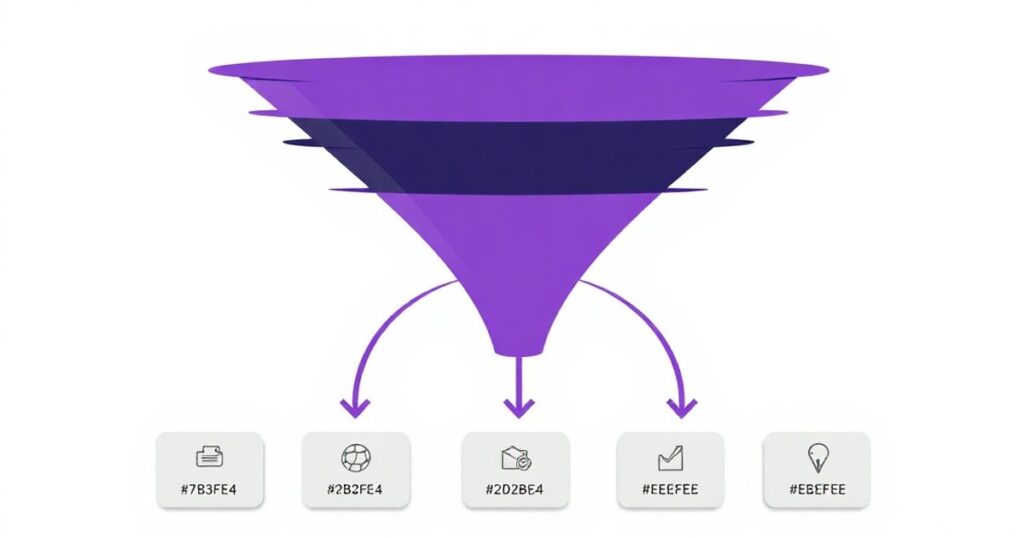
Most businesses have a marketing funnel. Very few have one that works. The difference usually comes down to one thing: whether the funnel was built around how customers actually make decisions — or around how the business wishes they would.
This guide breaks down how to map a real customer journey and build a funnel that moves the right people from first touch to signed contract, without wasting budget on the gaps in between.
What a Marketing Funnel Actually Is (And Isn’t)
A marketing funnel is a framework for understanding where a potential customer is in their decision-making process — and what they need to see, hear, or experience to take the next step.
It is not a single ad campaign. It is not just a landing page. And it is definitely not something you set up once and leave running.
In practice, a B2B funnel typically has three core stages:
- Top of Funnel (TOFU) — Awareness: The prospect has a problem but may not know you exist or even fully understand their options.
- Middle of Funnel (MOFU) — Consideration: They are actively researching solutions. Comparing vendors. Reading reviews. Asking colleagues.
- Bottom of Funnel (BOFU) — Decision: They are ready to act. What they need now is trust, clarity, and a reason to choose you specifically.
Start With the Customer Journey, Not the Ad Platform
Before you build anything, map how your actual customers make purchasing decisions. Talk to recent clients. Look at your CRM data. Ask your sales team what objections come up most often.
You are trying to answer three questions for each stage of the funnel:
- What is the prospect thinking or feeling at this point?
- What information do they need to move forward?
- What action do you want them to take next?
This exercise almost always reveals gaps. A common one: businesses spend heavily on awareness ads but have no structured follow-up for people who visit the site and leave without converting. The top of the funnel is full. The middle leaks.
Matching Content and Channels to Each Funnel Stage
Awareness (TOFU)
At this stage, the goal is reach and relevance — not conversion. You are introducing your brand to people who fit your target profile but have not yet engaged with you.
Effective formats here include educational blog content optimised for search, short-form video on LinkedIn or Meta that addresses a problem your audience recognises, and display or social ads designed to build familiarity rather than push for an immediate click.
Consideration (MOFU)
Now the prospect knows they have a problem and is actively looking for solutions. This is where you need to demonstrate credibility and differentiation.
What works well at this stage: detailed case studies showing measurable outcomes, comparison content that helps them evaluate their options, remarketing campaigns targeted at people who visited your site or engaged with your content, and email sequences for leads who have opted in but have not yet taken action.
One metric to watch here is time-to-next-action. If prospects are stalling between first contact and a sales conversation, the MOFU content is either missing or unconvincing.
Decision (BOFU)
At the bottom of the funnel, friction is your enemy. The prospect is close to a decision. Anything that creates doubt or confusion at this point costs you the deal.
Strong BOFU assets include clear, specific service pages with direct calls to action, social proof in the form of testimonials or verified results, transparent pricing or at minimum a clear process for getting a quote, and paid search campaigns targeting high-intent keywords — the searches that signal someone is ready to hire, not just research.
The Handoff: Where Most Funnels Break Down
The most expensive mistake in B2B marketing is not spending too much at the top of the funnel. It is failing to connect the stages.
A prospect who downloads a guide and receives no follow-up is a wasted lead. Someone who clicks a retargeting ad and lands on a generic homepage instead of a relevant landing page is likely to bounce. A sales team that gets inbound leads but has no context about how that lead found you or what they engaged with will close at a lower rate.
Building the funnel means designing the transitions deliberately — what triggers the next touchpoint, what message they receive, and how quickly.
Measurement: Know What to Track at Each Stage
Funnel performance cannot be evaluated with a single metric. Each stage has its own indicators:
- TOFU: Impressions, reach, brand search volume, organic traffic growth
- MOFU: Engagement rate, time on site, lead magnet downloads, email open and click rates
- BOFU: Conversion rate, cost per lead, lead quality score, sales close rate
If your BOFU conversion rate is strong but lead volume is low, the awareness stage needs work. If you have plenty of traffic but low BOFU conversion, the problem is usually in how well the MOFU content builds trust and filters intent.
Putting It Together
A well-built marketing funnel is not complicated — but it does require honest thinking about where your current setup has gaps. Most businesses find that they have been running disconnected tactics rather than a joined-up system.
Start by mapping the journey your best customers actually took. Then work backwards to make that path easier for the next hundred.
If you would like a structured review of how your current funnel is performing — or want to build one from scratch with paid, organic, and automation components working together — get in touch with the DPU team. We have run this process across 17 countries and 356+ projects. We know where the gaps usually are.
Back to Blog