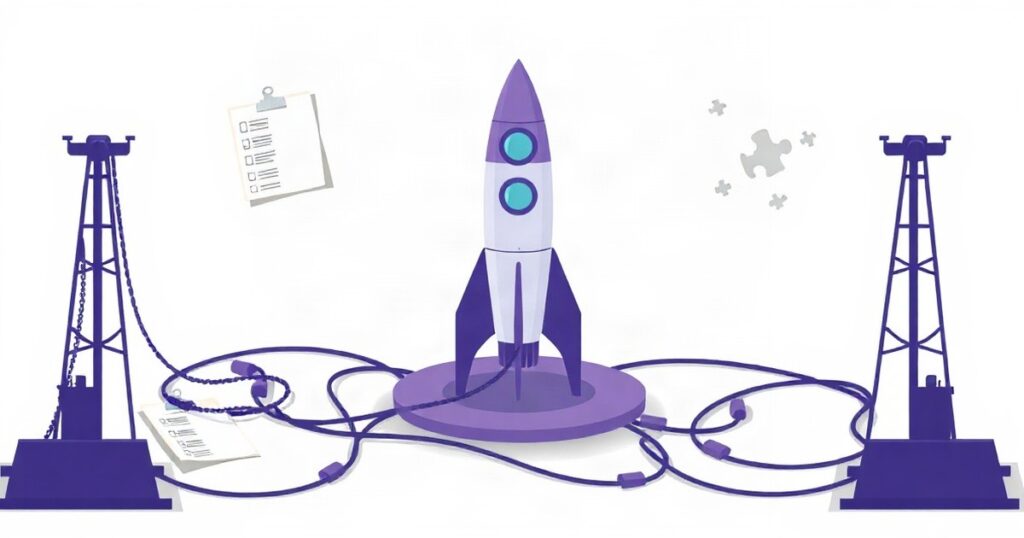
Most B2B lead generation campaigns don’t fail because of bad ads. They fail because of decisions made in the week before anything goes live — decisions about targeting, offers, and measurement that quietly guarantee the campaign will underperform regardless of how much budget gets loaded in.
After running campaigns across 17 countries and dozens of B2B verticals, the pre-launch mistakes we see are remarkably consistent. Here’s what they look like in practice.
The Audience Definition Is Too Broad — or Too Narrow
On LinkedIn, a common setup looks like this: job titles set to „Manager OR Director OR VP OR C-Suite,” industries left at defaults, company size unrestricted. The targeting technically reaches decision-makers, but so does every other generic B2B campaign. The CPLs end up high, the leads unqualified, and the conclusion drawn is that „LinkedIn doesn’t work for us.”
The opposite problem happens on Google: exact match keywords only, a tightly restricted list of 12 terms, negative keywords applied so aggressively that the campaign captures maybe 30% of the relevant search volume. Budget sits unspent. No data comes in. The campaign gets paused for „poor performance” after two weeks.
The fix isn’t finding a magic middle — it’s building the audience definition around a specific buyer profile, then testing one variable at a time. Who exactly has the authority and the budget? What problem are they actively searching for a solution to? Start there, not with the platform’s suggested audience.
The Offer Isn’t Designed for the Buying Stage
A „Book a Demo” CTA works when someone already understands what your product does and is evaluating options. It does not work when your buyers have never heard of you and are still figuring out whether they have the problem you solve.
This is the single most common mismatch in B2B campaigns. Companies send cold traffic — people who clicked a LinkedIn ad or searched a broad informational term — straight to a sales-qualified call request. Conversion rates of 0.3–0.8% get written off as „normal for B2B” when they’re actually a symptom of a funnel architecture problem.
The question to ask before launch: where in the buying process does this specific audience sit? Cold traffic needs a lower-commitment entry point — a guide, a diagnostic tool, a short webinar, a useful calculator. Warm retargeting audiences are the right place for demo requests and direct sales conversations.
There’s No Plan for What Happens to a Lead After the Form
This one is almost uncomfortable to mention because it’s so common. A campaign launches, leads come in, and they sit in a spreadsheet or a CRM inbox for three to five business days before anyone follows up. By that point, the lead has either solved their problem another way or forgotten they filled in the form.
B2B lead response time has a measurable impact on conversion to pipeline. Studies consistently show that responding within the first hour increases the likelihood of qualifying a lead significantly compared to responding 24 hours later. Before a campaign goes live, the follow-up workflow needs to be defined: who gets the lead notification, what’s the response template, what’s the SLA, and how does a lead move from marketing-qualified to sales-qualified?
If that process doesn’t exist, the campaign is generating leads for a system that isn’t ready to handle them.
The Conversion Tracking Is Either Broken or Measuring the Wrong Thing
Running a campaign without verified conversion tracking is not just a measurement problem — it actively corrupts the algorithm’s optimization. If Google’s Smart Bidding or Meta’s Advantage+ doesn’t have accurate conversion signals, it cannot learn which clicks are actually turning into leads. It will optimize toward whatever it can measure, which is often just clicks or landing page views.
Before any B2B campaign goes live, three things should be confirmed:
- The conversion event fires correctly on a real form submission (not just a page view of the thank-you URL)
- The conversion is attributed with the right value and category so the algorithm knows what it’s optimizing toward
- There’s a secondary metric — time on page, scroll depth, or a micro-conversion — to gather signal in the early days when form submissions are sparse
This takes about two hours to set up properly. Skipping it costs weeks of wasted spend and corrupted data that takes months to clean up.
The Landing Page Doesn’t Match the Ad’s Promise
Ad copy that leads with „Cut your reporting time by 40%” and then sends traffic to a generic homepage with five service categories and a stock photo of a handshake is not a funnel. It’s a traffic dump.
Message match — the degree to which the landing page continues the specific conversation the ad started — is one of the highest-leverage factors in B2B conversion rates. The headline on the landing page should echo the ad. The proof points should be relevant to the buyer the ad targeted. The CTA should be consistent with what was promised.
Building a dedicated landing page for each campaign or ad group takes more time upfront. It consistently produces better results than sending traffic to an existing page and hoping it converts.
What a Proper Pre-Launch Checklist Looks Like
The campaigns that perform well from week one share a common trait: the strategic and technical groundwork was done before the first euro of budget was committed. That means:
- A written buyer persona specific to this campaign — not a general ICP, but a defined profile with job title, company size, and the specific trigger that would make them click an ad today
- An offer matched to the buyer’s stage in the purchase journey
- A documented lead handling process with a named owner and an SLA
- Verified conversion tracking with test submissions confirmed in the platform’s reporting
- A dedicated landing page with a consistent message from ad to form
- A defined minimum data threshold before any optimization decisions are made — typically 30–50 conversion events per ad set or campaign
None of this is complicated. It’s just the work that gets skipped when the pressure is to launch fast.
The Launch Date Is Not the Starting Line
In B2B lead generation, the campaigns that look effortless — consistent lead volume, reasonable CPLs, sales team that actually wants more — are the ones where most of the real work happened before anyone touched the campaign settings. The launch date is when you find out whether that work was done.
If you’re planning a B2B campaign and want a second set of eyes on the strategy before budget is committed, that’s exactly the kind of review we do at DPU. It’s faster to fix these problems on paper than in a live account.
Back to Blog